Cyclone dust collectors are key equipment for dust control. They work in grain storage and processing industries. Understanding their structure helps with better comprehension and application.
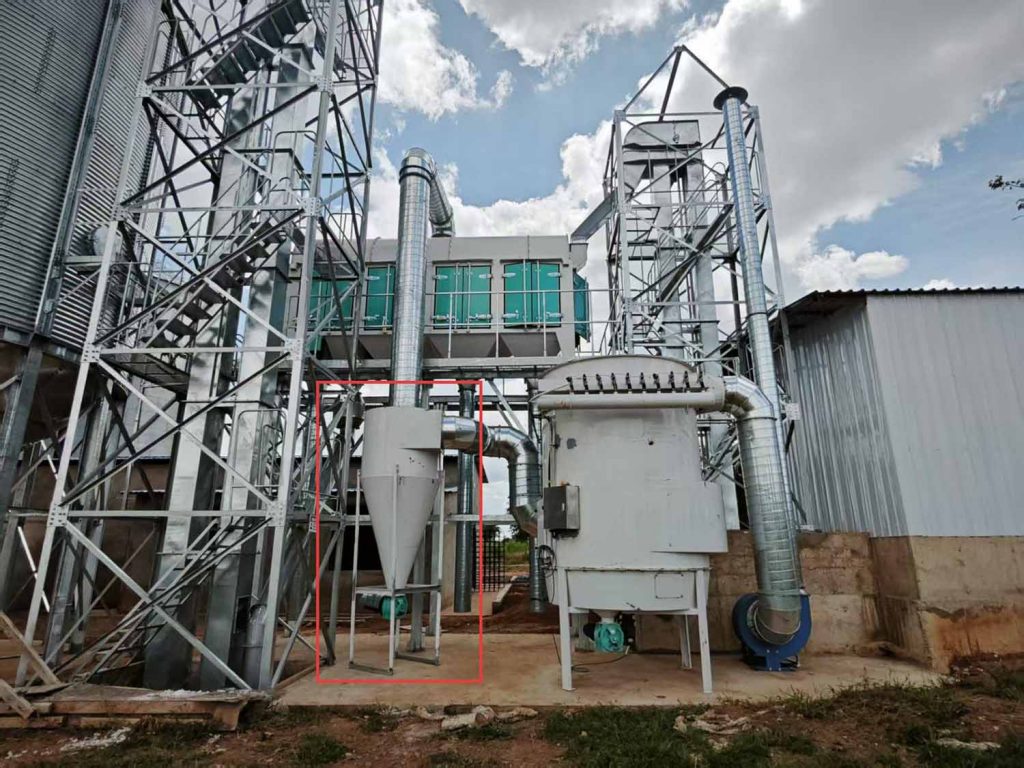
Basic Components
Cylinder
The cylinder is a core component. It contains the rotating airflow mainly. Its diameter and height affect rotation speed directly. They also influence centrifugal force strength. Optimizing cylinder geometry improves rotation efficiency. This enhances dust particle separation.
Cone
The cone sits below the cylinder. It guides dust particles into the hopper mainly. Cone angle and length affect separation and deposition significantly. Proper design reduces dust re-entrainment. This improves dust removal efficiency.
Inlet Pipe
The inlet pipe carries dusty gas into the collector. Its design is crucial for airflow distribution and rotation. It usually enters the cylinder tangentially. This creates strong rotational motion.
Outlet Pipe
The outlet pipe discharges cleaned gas. Its design must ensure smooth discharge. It also should avoid disturbing dust deposition. The outlet pipe positions centrally typically. It installs coaxially with the cylinder.
Dust Hopper
The dust hopper is the bottom component. It collects and stores separated dust. Design must consider dust flowability. This prevents clogging. The hopper usually has discharge devices. These include screw conveyors or rotary valves. They enable continuous dust removal.
Key Design Points
Airflow Path Optimization
Optimize inlet and outlet pipe positions and shapes. This ensures stable rotational motion inside. Rotation aids dust particle separation. It also reduces airflow turbulence. This lowers equipment energy consumption.
Material Selection
Material choice affects service life and performance directly. The outer shell usually uses high-strength steel. This ensures structural integrity. Select heat-resistant or corrosion-resistant materials for special conditions. These include high-temperature or corrosive environments.
Sealing PerformanceGood sealing is vital for efficiency and environmental protection. Ensure all connections seal properly. No leakage should occur. This reduces dust re-emission. It also improves operational efficiency.
Choosing the right supplier is crucial for equipment quality, performance,…
Choosing the right cyclone dust collector reduces dust concentration effectively.…


 WeChat:+8613598071775